12 Best Link Building & Backlink Tools for SEOs and Agencies in 2026
Last updated: July 19, 2026 · Written by Swapan, SEO strategist at SEOExpertStuff, covering link-building tools and outreach workflows
All tools listed were reviewed and pricing verified as of July 2026. Where a stat couldn’t be traced to a public source, it’s described directionally rather than as a precise figure — see notes below.
I’ve rebuilt this stack more times than I’d like to admit. Half the tools overlap. The other half don’t talk to each other. And somewhere in the middle, you’re paying for three subscriptions to do the job of one well-chosen one.
Link building in 2026 isn’t the game it was two years ago, either. Google’s gotten better at telling earned authority from manufactured signals — the days of a spreadsheet full of directory links moving the needle are long gone. AI Overviews, Perplexity, and ChatGPT also lean on domains with strong, trustworthy link profiles when they decide what to cite. A backlink isn’t just a ranking signal anymore. It’s part of how your brand shows up when someone asks an AI model instead of Google.
So this guide is organized the way I’d actually explain it to a client: by where a tool fits in the workflow — research, outreach, contact-finding, digital PR — rather than as a flat top-12 list. Build the stack in stages, and you end up covering the whole process instead of paying for five tools that quietly do the same thing. Whether you call them link building tools, link building software, or outreach platforms, they all solve the same problem — this guide covers the full stack either way.
Table of Contents
- What Link Building Actually Involves
- How to Evaluate a Link Building Tool Before You Buy
- Which Stack Fits Your Team?
- Backlink Research & Competitor Analysis
- Outreach & Relationship Management
- Finding the Right Contact
- LinkedIn & Multichannel Outreach
- Digital PR & Journalist Request Platforms
- The Free Tool You Shouldn’t Skip
- 2026 Link Building Tool Stack at a Glance
- Quick Comparison Table
- Common Link Building Mistakes These Tools Help You Avoid
- Frequently Asked Questions
- Final Thoughts
What Link Building Actually Involves
Link building, at its core, is just earning inbound links from other websites to your own. Search engines read those links as votes of confidence — the more relevant, authoritative sites that link to you, the more trust and topical relevance Google hands your pages. (Pair this with a broader look at the core SEO tools worth having in your stack first if you haven’t already.)
Not all links carry the same weight. Some actively hurt you. One link from a respected, topically relevant publication can outperform a hundred links from spammy directories, and a backlink profile stuffed with low-quality or manipulative links can trigger a penalty instead of a boost. I’ve inherited a few of those profiles from previous agencies and cleaning them up is never fun. That’s the whole case for the right tooling: it’s the difference between chasing junk links and spending your time on the handful of placements that actually move rankings.
How to Evaluate a Link Building Tool Before You Buy
Before you add another line item to your SEO budget, run any tool through a few questions. The first is index freshness. A tool working off a three-month-old crawl will show you dead links and missed opportunities — Ahrefs and Semrush refresh continuously, and smaller tools often lag behind. I learned this the hard way chasing a prospect that had already gone quiet on a client months earlier.
- Real quality signals, not raw counts. Domain Rating, Trust Flow, topical relevance, and traffic estimates matter far more than a big backlink number.
- Channel fit. Email-only outreach is leaving replies on the table these days — more on that in the LinkedIn section below.
And then there’s cost per link, which is the number that actually matters and the one most vendors would rather you not think about. A $30/month tool that returns nothing beats a $500/month one you never fully use. Price against your outreach volume, not your budget ceiling.
Which Stack Fits Your Team?
There’s no single “best” stack. It depends on how much outreach volume you’re actually running and who’s doing it — and I’ve set up all three of these for different clients, so this isn’t theoretical.
Solo consultant or freelancer: Start lean. Majestic or Moz Pro for research (both cheaper to get into than Ahrefs), BuzzStream for outreach since it scales down affordably, Hunter.io’s free tier for contacts, and Featured/HARO for free digital PR upside. Realistically, that whole stack runs under $200 a month.
Small in-house team (1–3 people on SEO): Semrush is the more efficient single subscription — backlink research, competitor gaps, and a built-in outreach module in one tool instead of paying for research and outreach separately. The outreach module isn’t as polished as a dedicated tool, to be honest, but it’s good enough that most small teams don’t need a second subscription. Layer in Hunter.io’s paid tier once volume grows, and monitor two digital PR platforms rather than one — the overlap between them is lower than most people assume.
Agency managing multiple clients: This is where Ahrefs (research depth across many domains at once) and Pitchbox (outreach at real volume, with reporting clients can actually see) earn their higher price tags. Add Dripify once volume justifies a second channel. Agencies running LinkedIn outreach alongside email tend to see meaningfully better reply rates than email alone.
Backlink Research & Competitor Analysis
This is the category most people mean when they search for link building software or backlink platforms — tools built specifically to analyze and grow your link profile. Every campaign should start here: understanding your current backlink profile and finding the gaps between you and your competitors.
For a broader (if due for a refresh) look at where these tools have come from, see our earlier roundup of link building SEO tools.
Ahrefs is still the strongest pure research tool on the market, and it’s the one I open first on a new client. Content Explorer and Link Intersect show exactly which sites link to competitors but not to you — probably the fastest way to build a qualified prospect list I’ve found. Site Explorer also gives you Domain Rating, referring domain counts, and anchor text distribution for any site. Starting price sits around $129/month, steep for a solo blogger, easy to justify for an agency running multiple campaigns.
Semrush bundles similar research into a much broader SEO suite — keyword research, site audits, and a built-in outreach module that suggests prospects and tracks email sequences without a separate platform. It won’t out-research Ahrefs and the outreach module feels a step behind BuzzStream, but if you want research and basic outreach under one subscription instead of two, it’s the more efficient buy at around $140/month for the Pro tier.
Moz Pro earns its spot for two things: Domain Authority, still one of the most widely recognized authority metrics even among clients who’ve never touched the tool itself, and Spam Score, which flags toxic links before they drag a profile down. Its Link Explorer has a Link Intersect feature comparable to Ahrefs’s too, at a friendlier $99/month entry point.
Majestic is the specialist. Instead of one authority score, it splits link quality into Trust Flow (how trustworthy the linking sites are) and Citation Flow (how much link equity they pass) — a more nuanced read on whether a prospective link is worth pursuing. Its Historic Index reaches back further than most competitors’, and at roughly $50/month it’s a solid budget add-on rather than something you’d run alone.
Outreach & Relationship Management
Finding link prospects is half the job. Getting a real person to say yes is the other half. Most campaigns actually fail here, not at the research stage.
Pitchbox is built for volume — it automates prospecting, personalized email sequences, follow-up reminders, and reporting, and plugs directly into Ahrefs and Moz so you’re not exporting spreadsheets between platforms by hand. It’s the tool most agencies graduate to once they’re running outreach at scale. My one real complaint: the reporting dashboard is clunky enough that I still export half of it to Sheets before sending anything to a client. Pricing is custom, typically starting in the low four figures a month, which puts it firmly in agency territory.
BuzzStream takes a more relationship-first approach — its contact database tracks every interaction with a prospect, past emails, social profiles, notes, so outreach feels personal instead of templated. That matters when you’re pitching the same editor a second or third time. It integrates with CRMs and email clients, and lower-tier plans starting around $24/month put it within reach of teams Pitchbox’s pricing would otherwise rule out. It’s my default recommendation for solo consultants.
Respona has carved out a niche finding prospects based on content relevance rather than just domain metrics — it looks for pages already discussing your topic and surfaces whoever would plausibly care about your pitch. Paired with built-in email finding and sequencing, it removes the need for a separate Hunter.io subscription for a lot of users, starting around $70/month.
Finding the Right Contact
Hunter.io does one job extremely well: finding and verifying email addresses tied to a domain. Paste in a URL and it returns likely contacts with a confidence score, plus bulk domain search for building a list of fifty prospects instead of one. It’s unglamorous, but I don’t think I’ve run a campaign without it. It integrates with Mailchimp, HubSpot, and most outreach tools above, and the free tier — 25 searches a month — is generous enough for smaller campaigns before you need the roughly $49/month paid plan.
LinkedIn & Multichannel Outreach
Dripify isn’t on most “link building tools” lists, but it should be. I was skeptical of LinkedIn outreach for backlinks until I ran it alongside email for a client last year — reply rates were meaningfully better, though I’d be cautious about any specific percentage you see quoted in this space, mine included, since it isn’t consistently measured the same way industry-wide. The likely driver is simple: a connection request just doesn’t feel like spam the way a cold email does. Dripify builds automated LinkedIn sequences and lets you personalize at scale, run alongside email rather than instead of it. If your outreach is still email-only, this is the highest-leverage gap to close in 2026.
Digital PR & Journalist Request Platforms
Earning a link because a journalist quoted you as an expert source is one of the strongest link-building tactics available — it’s an editorial vote of confidence, not a link you asked for directly, which makes it valuable both for SEO and for genuine brand authority. It’s also worth pairing with a broader digital PR mindset — see our piece on how social signals and shares tie into SEO ranking for the wider context.
HARO / Featured went through a genuinely messy stretch — shut down, rebranded as Connectively, discontinued again — before landing back under Featured, the current owner’s “AI co-pilot for PR” platform. It’s back to the original free, email-based model, delivering requests a few times a day. I’ve had client sources land in Forbes off a HARO reply that took less than ten minutes to write, and I’ve also had weeks where nothing in the inbox was remotely relevant. Both are true of this tool.
Connectively sits alongside HARO under the same parent company, but as a standalone platform instead of an email digest — worth it if you’d rather browse and filter live requests than dig through an inbox.
Qwoted earns a spot specifically if you’re targeting major outlets — it’s known for surfacing requests from publications like Forbes and Reuters, with a free tier and a paid tier for priority visibility.
Don’t pick just one. Overlap between any two journalist-request platforms tends to run lower than people assume, so checking only one usually means missing a real chunk of relevant requests. A serious digital PR effort means running two or three in parallel. There’s an AI-visibility angle here too — more clients are asking how their placements tie into what AI search tools cite, and hardly anyone has a reliable way to track that yet. Which means it’s still wide open for whoever builds the habit early.
The Free Tool You Shouldn’t Skip
Google Search Console costs nothing and tells you things paid tools can’t: which queries are already sending traffic, which pages Google has actually indexed, and — this is the one people skip — a list of your existing external and internal links straight from Google’s own data. It flags manual actions and crawl errors too, quietly undermining campaigns you’re paying to run if left unchecked. I still start every new client audit here before opening anything else on this list. If it isn’t already connected to every site you manage, that’s step one. (For the traffic side of this, our guide to boosting website traffic is a useful companion read.)
2026 Link Building Tool Stack at a Glance
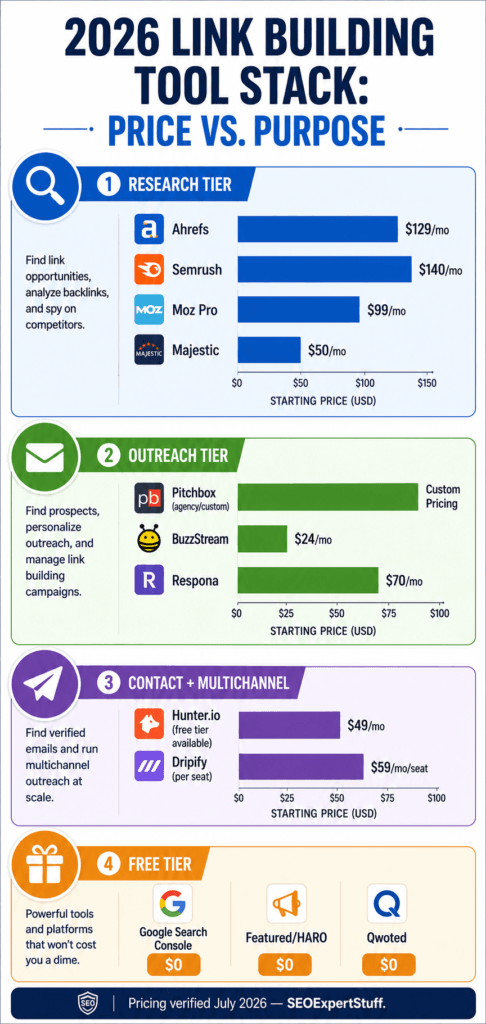
Before comparing individual tools, it helps to understand how each one fits into the broader link building workflow. Some tools are designed for backlink research, others for outreach, contact discovery, LinkedIn prospecting, or digital PR. The right choice depends less on finding one “best” tool and more on building a stack that matches your team, outreach volume, and campaign goals.
Quick Comparison Table
| Tool | Best For | Starting Price | Free Option |
| Ahrefs | Backlink & competitor research | ~$129/mo | Limited free tools |
| Semrush | All-in-one SEO + outreach | ~$140/mo | 7-day trial |
| Moz Pro | Domain Authority & spam scoring | ~$99/mo | Limited free tools |
| Majestic | Trust Flow / Citation Flow analysis | ~$50/mo | Limited free searches |
| Pitchbox | High-volume agency outreach | Custom (agency-tier) | Demo only |
| BuzzStream | Relationship-based outreach | ~$24/mo | 14-day trial |
| Respona | Content-based prospecting + outreach | ~$70/mo | 14-day trial |
| Hunter.io | Email finding & verification | ~$49/mo | Yes (25 searches/mo) |
| Dripify | LinkedIn outreach automation | ~$59/mo/seat | Free trial |
| Featured / HARO | Journalist source requests | Free | Yes |
| Qwoted | Journalist requests, major outlets | Freemium | Yes |
| Google Search Console | Link & indexing monitoring | Free | Fully free |
Pricing verified as of July 2026 — confirm current rates directly with each vendor before budgeting, as these shift often.
Common Link Building Mistakes These Tools Help You Avoid
Chasing volume over relevance is the one I see most often. Ten links from topically relevant, moderate-authority sites will typically outperform a hundred from irrelevant high-DR sites that only exist to sell links. Volume feels productive; relevance is what actually ranks.
- Ignoring existing toxic links. Run a spam audit at least quarterly — Moz and Semrush both flag this — and disavow anything genuinely harmful instead of letting it sit.
- Templated outreach at scale. Automation should speed up personalization, not replace it. A pitch that clearly wasn’t written for that editor gets ignored or marked as spam.
- Single-channel outreach. Email-only campaigns leave replies on the table in 2026; pairing email with LinkedIn tends to help.
And don’t treat digital PR as one-and-done. Journalist request platforms reward consistency — the sources who reply fast and often are the ones editors keep coming back to.
Frequently Asked Questions
What’s the single best link building tool for a small team?
Semrush is the most efficient single subscription — it covers backlink research, competitor gap analysis, and basic outreach in one platform, so you’re not paying for three separate tools before you’ve earned your first ten links.
What is the best link building software for agencies?
For agencies managing multiple clients, Ahrefs paired with Pitchbox is the standard combination — Ahrefs for research depth across many domains, Pitchbox for outreach at volume with client-facing reporting. Smaller agencies often start with Semrush alone before splitting into a dedicated research-plus-outreach stack.
What are the best backlink tools in 2026?
Ahrefs, Semrush, and Moz Pro are the three most widely used backlink analysis tools. Ahrefs has the largest backlink index, Semrush bundles backlink data into a broader SEO suite, and Moz Pro is the most budget-friendly entry point with its Domain Authority and Spam Score metrics.
Is HARO still around in 2026?
Yes. After being shut down and rebranded as Connectively, it was revived under Featured and is back to its free, email-based model, running alongside Connectively as a separate platform from the same parent company.
Do I need a paid backlink tool, or is Google Search Console enough?
Search Console tells you about your own site’s links and performance, but it won’t show you competitor backlink gaps or let you filter prospects by authority metrics. For serious link building, you’ll want at least one paid research tool alongside it.
How much should a small business budget for link-building tools monthly?
A lean but functional stack — one research tool (Moz or Majestic), one outreach tool (BuzzStream), and Hunter.io’s free tier — can run under $200/month. Agencies managing multiple clients typically spend well beyond that once Pitchbox or Semrush enter the mix.
What’s the biggest shift in link building tools since 2023?
Two things: outreach has gone multichannel (LinkedIn alongside email), and the HARO/Connectively saga has fractured journalist-request platforms into several competing options rather than one dominant tool.
Final Thoughts
No single tool here runs a full campaign on its own, and any article that tells you otherwise is selling you something. Build a small stack that covers research, outreach, and monitoring without redundant overlap, then give it consistent, patient effort — that’s really the whole trick. Editorial links are earned the same way they always have been: by pitching something genuinely worth linking to, to the right person, at the right time.
If you’re actively building backlinks and have a genuinely useful, well-researched piece on SEO, content strategy, or digital PR that hasn’t been published anywhere else, we’re currently accepting guest contributions on these exact topics. Check out our Write for Us guidelines — it’s a solid way to pick up a high-quality, editorially earned backlink of your own while sharing what’s actually working in your campaigns.
About The Author
